
Garage Door Stuck Halfway? What It Means
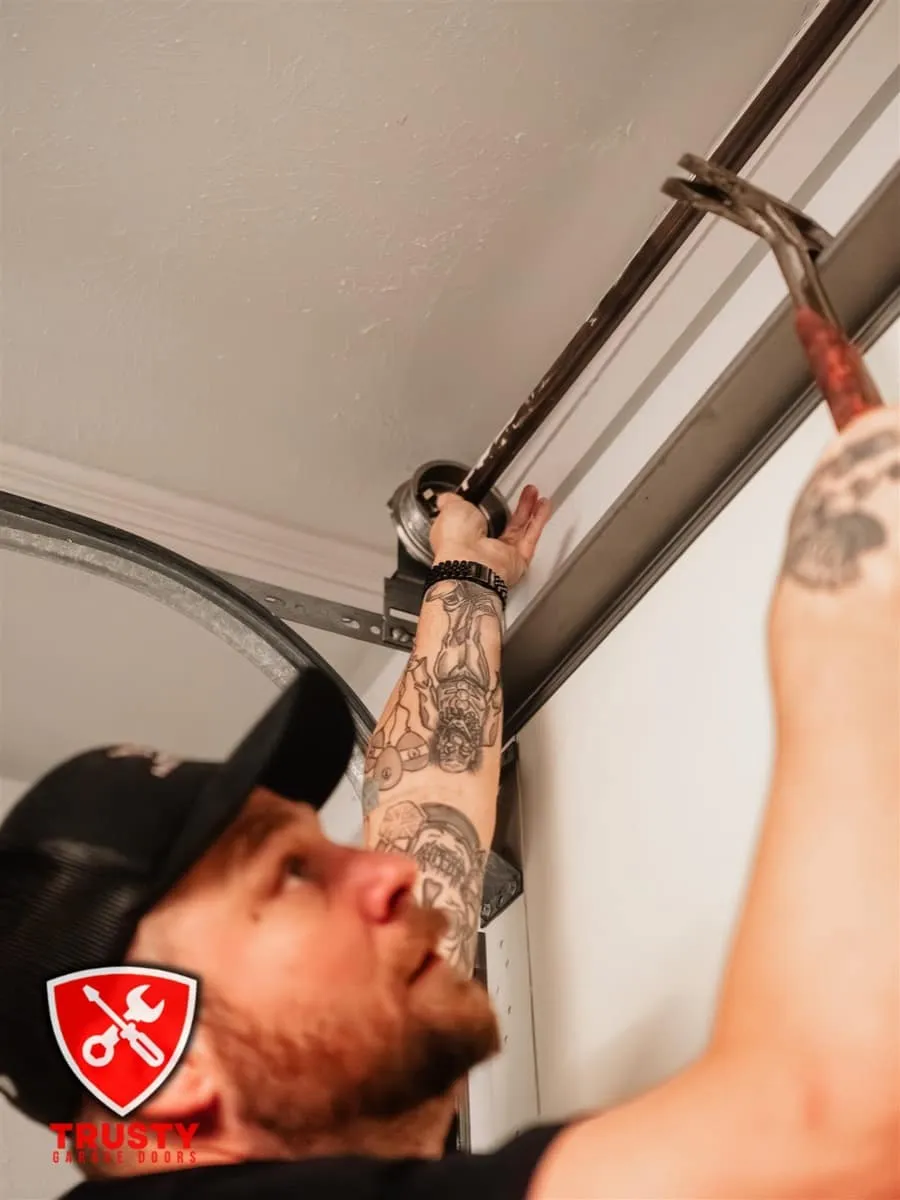
It happens at the worst time — you’re already running late, you hit the button, the door starts going up (or down), and then it just… stops. Frozen at chest height. Car stuck. Clock ticking.
A door that quits mid-travel can mean several different things, and the fix depends entirely on which one you’re dealing with. Here’s how to figure that out quickly.
Look for the Obvious First
Before assuming something is broken, walk both sides of the tracks and scan for anything blocking the path. A bike that rolled over, a trash can that shifted, a garden hose coiled in the wrong place — these will stop a door dead mid-travel with no other warning signs. If there’s a physical obstruction, clearing it may be the whole fix.
Also check the tracks themselves. A dent or crimp in the vertical section — even a small one — can wedge a roller and bring the door to a stop. This is common in homes where someone’s gotten a little too close pulling in or out. DFW garages with tight two-car openings see this more often than you’d think.
If the tracks look clear and there’s nothing in the way, now you’re diagnosing.
A Broken Torsion Spring Is the Most Likely Cause
If the door went partway down and suddenly stopped, the torsion spring is the first thing to rule out. When a spring breaks, the counterbalance system that handles most of the door’s weight disappears instantly. The opener tries to lift or lower the door alone, hits a load it can’t handle, and the safety cutoff kicks in mid-cycle.
Look up at the horizontal spring above the door — it’s mounted on the metal shaft across the top of the opening. A broken spring has a visible gap in the coil, usually a two-to-four-inch separation. It looks like the spring was cut in half.
We had a call in Frisco two weeks ago — homeowner had the door stop dead halfway down with her truck trapped inside, spring completely snapped, and she’d been pressing the button over and over wondering why nothing was happening. Every attempt just ground the opener motor harder against a dead load.
Don’t keep running the opener through a broken spring. You’ll burn out the motor or pull the cables off the drums. And don’t try to lift a heavy door by hand without propping it — if the spring is broken, the door has lost its counterbalance and it is genuinely heavy. Use two people, or call someone.
Spring replacement is not a safe weekend project. Torsion springs store significant mechanical energy, and releasing that energy incorrectly causes serious injuries. See our garage door spring replacement page if you want to understand what the repair involves and roughly what it costs.
When the Opener Runs But the Door Doesn’t Move
If you hear the opener running and the trolley moving along the rail, but the door stays put, the spring is probably fine. What you’re likely dealing with is a disconnected carriage.
The trolley (the piece that rides the rail) connects to the door via a carriage mechanism. If someone pulled the emergency release cord without realizing it, or if the carriage failed internally, the opener goes through its whole motion and the door does nothing.
Test it: grab the door by hand at mid-height and try to move it up and down. If it rolls smoothly and feels reasonably light, you’ve got a disconnect issue — not a spring problem. A tech can reconnect or replace the carriage quickly. This one’s usually a same-day fix.
Worn Rollers Jamming in the Track
Rollers that have cracked, seized, or gotten flat spots can wedge the door mid-track and stop it completely. In DFW attics, where summer temperatures push past 130°F, cheap nylon rollers degrade faster than manufacturers’ estimates account for. After enough heat cycles, they crack, and a cracked roller catching in a track joint is all it takes.
Look at the rollers along both tracks. If one is visibly broken, sitting crooked, or partially out of the track, you may be dealing with an off-track situation that needs careful attention before the door moves again. Don’t force it — a door that’s already off-track can bind harder and bend the track if pushed.
The Opener’s Safety Stop Triggered
Sometimes the door isn’t mechanically stuck at all. The opener stopped because it sensed too much resistance and cut the motor for safety. This is the force limiter doing its job.
The key test: pull the red emergency release cord to disconnect the door from the opener, then try moving the door manually. If it moves smoothly and feels balanced — light going up, controlled going down — then the opener’s force setting may just need a small adjustment, or something was temporarily binding (a stiff bottom seal, a cold snap, a wet threshold that swelled slightly).
If the door is hard to move by hand, or if one side feels heavier than the other, there’s a mechanical problem to fix before you reconnect the opener. An unbalanced door will keep tripping the safety stop until the underlying cause is addressed.
Getting Your Car Out Safely
If the door is stuck halfway and you need to move the vehicle:
- Don’t stand directly under the door.
- Pull the red cord hanging from the trolley to disconnect from the opener.
- Lift the door from the bottom with both hands. If the spring is broken, this takes effort — get a second person.
- Prop it open with a sturdy ladder on each side before going under it. Never trust a broken-spring door to hold itself up.
Get the car out, then lower the door all the way and leave it closed until a tech arrives. A garage stuck halfway open is a wide-open invitation.
When to Call a Pro
Broken spring — call immediately. Off-track door — call before moving it further. Anything that looks burned, bent, or obviously failed — same answer.
If the door moves freely by hand and the opener just tripped its safety limiter, you may be able to reconnect and try again carefully. But if it stops mid-travel a second time, don’t keep forcing it. Something is binding that needs to be found.
Our instant price calculator gives you a quick ballpark on spring replacement or a full door repair. Or just call us at (214) 624-6348 — we cover Plano, Frisco, Allen, McKinney, and surrounding DFW, usually same-day, and we’ll tell you exactly what’s going on before any work starts.
Nick founded Trusty Garage Door Repair in Plano and has spent 10+ years fixing garage doors across Dallas–Fort Worth. He still takes calls, still runs jobs, and writes these guides the way he explains things in a customer's driveway — straight, no upsell. Read Nick's story →
One tap tells Google you trust our guides, so they show up more in your own search results and AI answers.