
How to Tell If Your Garage Door Spring Is Broken
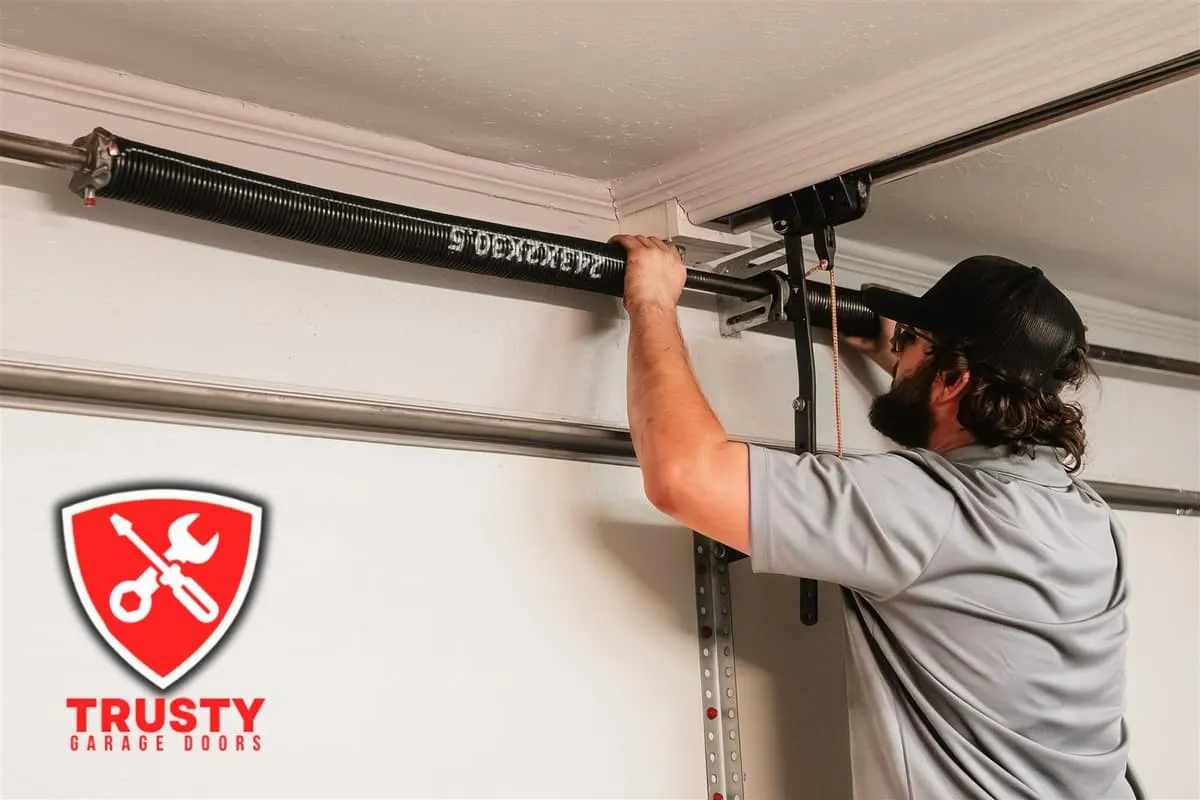
Your garage door spring is the single hardest-working part on the whole system. It’s the muscle that lifts a door that can weigh 150 to 350 pounds, and you barely notice it until the day it lets go. When a spring breaks, the door usually stops working right then and there, and a lot of folks here in Plano and across DFW assume the opener died. Nine times out of ten, it’s the spring.
Here’s how to tell the difference, what’s safe to look at yourself, and what you should leave alone.
The Fastest Way to Know: Look at the Spring
Most residential doors use a torsion spring mounted on a metal shaft above the door opening (some older or lighter doors use extension springs that run along the horizontal tracks on each side).
Go into your garage, leave the door closed, and look up.
- Torsion spring: If you see a clean 2-inch gap in the coil where the spring looks like it’s been snapped in two, it’s broken. An intact spring is one tight, continuous coil.
- Extension springs: Look down the tracks on both sides. A broken one will hang loose, be stretched out, or be in two pieces.
That visible gap is the most reliable sign there is. If you see it, you’ve found your answer, no guesswork needed.
Other Signs Your Spring Is Shot
You won’t always get a clear look at the coil, so here are the other telltale symptoms we see on service calls every week:
You heard a loud BANG
A breaking torsion spring releases a huge amount of stored energy at once. People describe it as a gunshot, a firecracker, or something heavy falling in the garage. If you heard a loud bang from the garage and now the door won’t open, that’s your spring about 95% of the time.
The door won’t go up (or only opens a few inches)
Hit the opener and the motor hums, the chain moves, but the door doesn’t budge or lifts a few inches and stops? The opener isn’t strong enough to lift the full weight of the door on its own. The spring does the heavy lifting, and without it, the motor is overwhelmed. Forcing it will burn out your opener, so stop trying.
The door feels incredibly heavy by hand
With the door closed, pull the red emergency release cord and try to lift the door manually. A door with a healthy spring should feel light, maybe 8 to 10 pounds of effort, and stay put when you let go halfway. If it feels like deadlifting a couch or slams back down the second you let go, the spring isn’t doing its job.
The cables are hanging loose
When a spring breaks, the lifting cables on each side often go slack and droop off the drums. If you see loose or dangling cables, that points straight to a spring problem.
The top section is crooked or the door is off track
Sometimes a sudden spring failure jerks the door and pulls one side out of alignment. If your door now looks cockeyed or jammed in the tracks, you may be dealing with a spring failure that turned into off-track damage.
Why DFW Springs Break When They Do
Springs are rated by cycles, usually about 10,000 (one up-and-down equals one cycle). For an average family, that’s roughly 7 years, but a few things speed it up here in Texas:
- Heat and cold swings. Our brutal summer attic heat followed by the occasional hard freeze stresses the metal. Temperature changes are a top reason springs snap in the dead of a January morning.
- Rust. Humidity and the odd ice storm cause micro-rust that weakens the coil. A little garage door lubricant a couple times a year goes a long way.
- Builder-grade springs. A lot of DFW homes built in the 2000s shipped with single, minimum-spec springs. Once they age out, they go.
What You Should NOT Do
I’ll be straight with you the way I’d tell my own neighbor: do not try to replace a torsion spring yourself. Those springs hold tremendous tension even when “broken,” and the tools and technique to wind them safely are not something to learn from a 5-minute video. Every year people end up in the ER with broken fingers, wrists, and worse. It is genuinely one of the most dangerous home repairs there is.
It’s also a job that’s hard to get right. The spring has to be sized to your exact door weight, and the wrong spring wears out fast or strains your opener.
What you can safely do: look for the gap, test the door weight by hand, and check the cables. That’s plenty to confirm what’s going on before you call.
Getting It Fixed
The good news is a spring replacement is a routine, same-day repair for a trained tech, usually an hour or two start to finish. If your door has two springs and one broke, we almost always recommend replacing both. They have the same age and cycle count, so the second one is right behind the first, and doing them together saves you a second service call.
Want to know what a spring replacement costs before you commit? Our instant price calculator gives you an honest estimate in about a minute, no email or pressure required. And if the door turned out to be a different issue, our general repair page covers the rest.
Still Not Sure? We’ll Tell You Straight
If you spotted a gap in the coil, heard that bang, or the door suddenly weighs a ton, it’s almost certainly the spring, and it’s not something to limp along with. A door that can drop unexpectedly is a real safety risk for kids, pets, and cars.
Give Trusty Garage Door Repair a call at (214) 624-6348 for same-day and 24/7 emergency service across the Dallas-Fort Worth metroplex, or grab an instant estimate from our price calculator. No bait-and-switch, no pressure, just an honest answer from a local Plano crew.
Nick founded Trusty Garage Door Repair in Plano and has spent 10+ years fixing garage doors across Dallas–Fort Worth. He still takes calls, still runs jobs, and writes these guides the way he explains things in a customer's driveway — straight, no upsell. Read Nick's story →
One tap tells Google you trust our guides, so they show up more in your own search results and AI answers.