
How Long Do Garage Door Springs Last in Texas?
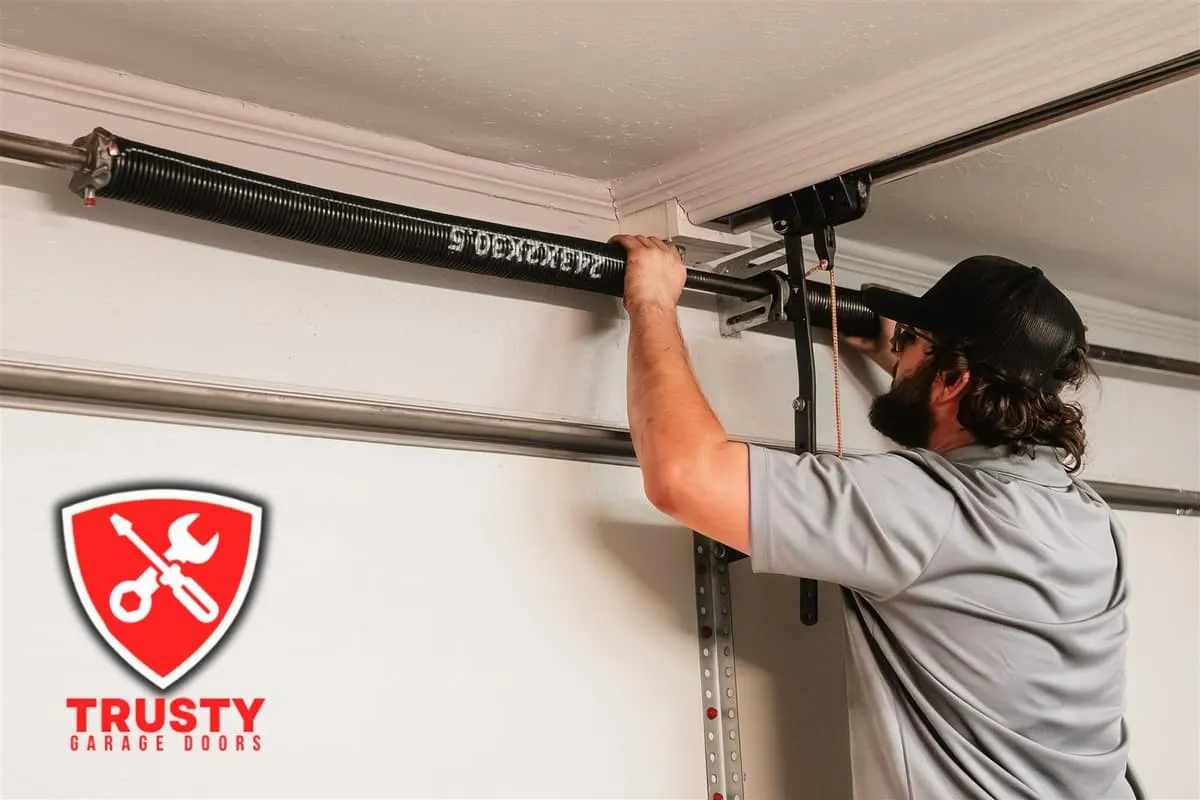
The spring on your garage door has a number built into its design that most homeowners never learn about. It’s called a cycle rating, and it’s the most honest answer to the question of how long that spring is going to last.
One cycle = one open + one close. A standard residential spring — the kind that’s been spec’d into new construction across Plano, McKinney, Allen, and the rest of DFW for the last two decades — is rated for 10,000 cycles. Run the math for a household that moves the door four times a day, and you get about 7 years before you’re past that rating.
That surprises a lot of people. Your refrigerator outlasts it. Your AC unit probably does too. But those springs are under load every single day, holding hundreds of pounds of tension, and in North Texas specifically, they’re doing it in one of the more punishing climates in the country for metal parts.
The Standard Lifespan — and Why Texas Shortens It
In a mild, stable climate, 10,000 cycles over 7–10 years is a reasonable target. Here, that’s the ceiling, not the average.
A garage attic in DFW can hit 140°F on a still August afternoon. Steel expands in that heat. Then a January blue norther rolls in, overnight lows drop into the teens, and that same metal contracts. Every big temperature swing is another micro-stress event on top of the mechanical stress of the door moving. Most springs in our area have been through hundreds of those cold-front transitions by the time they’re 8 years old.
Humidity does the rest. Springs are raw steel and almost nobody keeps them lubricated. In Frisco, Allen, and older parts of Richardson, we pull springs that look fine from the floor but have developed surface rust deep into the coil from years of exposure without any maintenance. Once corrosion gets into the wire, the spring’s effective life is already shortened — regardless of how many cycles are on the counter.
There’s also the builder-grade problem. A huge portion of DFW was built out through the 90s and 2000s — those massive subdivision booms in Frisco, Prosper, Little Elm. Nearly all of them shipped with single-spring setups using minimum-spec hardware. Nothing wrong with them when new. But a lot of those springs are now 15 to 20 years old, and they don’t owe anyone anything.
Estimating Where Yours Stand
You don’t need exact records. A rough estimate is enough.
Take the age of your spring (usually the same age as the door, unless it’s been replaced) and multiply by your daily cycle count. Four door movements a day × 365 days = 1,460 cycles per year. At 8 years old, that’s roughly 11,700 cycles — past the standard rating on most springs.
Again, that’s not a death sentence. Springs often run past their rating without issue, and some fail before reaching it. But if you’re in that range and you don’t know the spring’s history, it’s worth paying attention.
Signs the Spring Is Getting Tired
The most dramatic failure — the loud bang when a torsion spring snaps — gets all the attention. But springs usually give a little warning first.
The door feels heavier by hand
Pull the red emergency release cord on your opener and try lifting the door manually. A healthy spring should make it feel nearly weightless — 8 to 10 pounds of effort — and it should stay put wherever you leave it. If it feels like work, or if it drifts back down when you let go at waist height, the spring is losing tension.
Your opener has started straining
Openers are sized to move a balanced door, not do all the lifting themselves. When a spring loses tension, the motor compensates. You’ll notice it as a labored hum, slower travel, or an opener that runs longer than it used to on a normal open cycle. If this sounds like yours, the problem usually isn’t the opener.
Visible wear on the coil
Look up at the spring from a few feet back. Rust along the coils, a subtle separation in the wire, or a section that looks uneven compared to the rest are all signs of fatigue. We pulled a spring out of a house in Richardson last spring that had a flat spot in the coil the homeowner had never noticed — they’d chalked the “heavy door feel” up to the door just being old. The spring had maybe a year left in it.
The Simplest Thing You Can Do
Lubricate the spring coils two or three times a year. That’s it.
Not WD-40 — it dries out and leaves a residue that attracts grit. Use a garage door-specific silicone spray or white lithium grease and give the coils a light coat. The fall before cold weather hits is a good reminder to do it; spring is another. Takes ten minutes.
It keeps moisture off the steel, reduces micro-fatigue, and costs almost nothing. On a spring approaching end of life, it can genuinely add a year or two. On a newer spring, it’s just good practice that keeps corrosion from cutting the cycle rating short.
When to Replace — and the Two-Spring Rule
If your springs are past 10 years and haven’t been replaced, it’s worth a check. We’ll look at the tension, check for corrosion, and give you a straight read on where they stand. No upsell pressure — just an honest answer on whether you’re coasting fine or sitting on borrowed time.
One firm recommendation: if one spring has broken and you have two, replace both. They’ve been cycling together since day one. The surviving spring has lived the same life as the one that just failed. Doing them separately means a second service call a few months from now when the second one goes — and it usually does.
Our price calculator will give you a real cost estimate in under a minute if you want a number before calling. More detail on what the work involves is on our spring replacement page.
One Note on DIY
Looking at a spring, testing the door weight by hand, spotting wear on the coil — all fine and useful. Actually replacing a torsion spring is a different category entirely. Those springs hold significant stored energy even at rest, and winding them safely requires specific tools and real experience with the technique. It’s the one garage door repair job we consistently ask homeowners not to tackle on their own.
If yours are overdue or showing any of the signs above, give us a call at (214) 624-6348. We’re based in Plano and cover all of DFW — usually same-day service. No pressure, no bait-and-switch.
Nick founded Trusty Garage Door Repair in Plano and has spent 10+ years fixing garage doors across Dallas–Fort Worth. He still takes calls, still runs jobs, and writes these guides the way he explains things in a customer's driveway — straight, no upsell. Read Nick's story →
One tap tells Google you trust our guides, so they show up more in your own search results and AI answers.