
Can You Use a Garage Door With One Broken Spring?
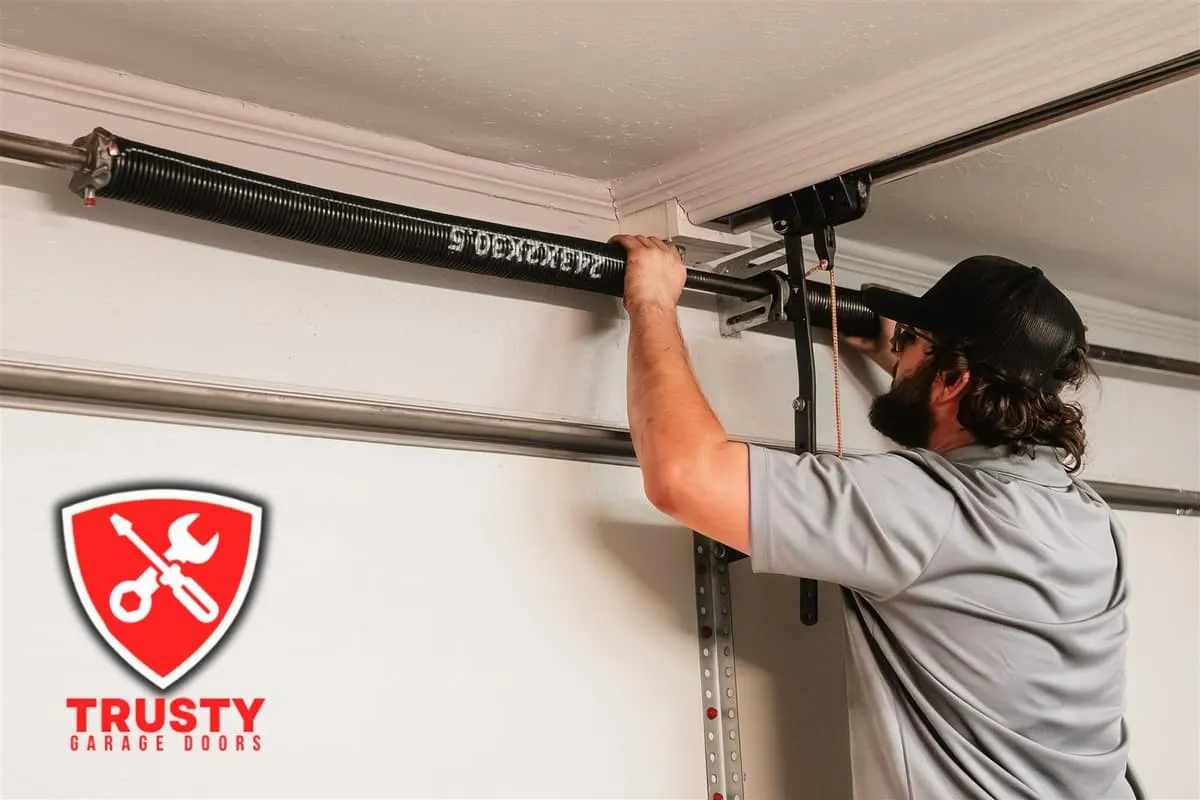
The spring snapped overnight and now you need your car. You’re standing in the garage wondering: can I just run the door anyway?
Short answer is yes, technically — the opener will try. But “will try” and “should” are different things, and the gap between them is where people end up with a much bigger repair bill than they started with.
What a Spring Is Actually Doing
Your garage door weighs anywhere from 150 to 350 pounds depending on the style and material. The spring system — torsion or extension — counterbalances that weight so your opener only has to move a fraction of it. A correctly balanced door feels nearly weightless when you pull the manual release and lift by hand.
When that balance disappears, the door is still connected and still moves. But now your opener is shouldering load it was never designed to carry. On a double-car door with two torsion springs, losing one means the motor is trying to lift half the door’s real weight by itself. On a single-car door with one spring, it’s doing everything. The motor doesn’t know any of this. It’ll try anyway.
Three Things That Go Wrong
The door can drop or rack. A door without proper spring tension doesn’t rise in a smooth, balanced arc. It can pull sideways in the tracks, bind partway up, or lurch if the opener surges. We’ve had calls around Allen and McKinney from homeowners who forced an unbalanced door open and watched it come off the track entirely. An off-track door is more labor-intensive to fix than the spring that started all of it — and in some cases the track itself gets bent in the process.
The opener motor burns out. Residential openers are sized for a balanced door. Running a heavy, spring-less door through a dozen cycles will overheat the motor, wear the drive system prematurely, and often trigger the thermal overload — which leaves you with neither a spring nor a functioning opener. We’ve seen this happen to people who figured they’d “just use it for a few days” until they got around to calling.
Cable misalignment. A snapped torsion spring frequently lets the cables go slack or shift on the drums. A cable that’s not seated correctly can slip off mid-operation. On a heavy door moving at speed, that goes from zero to dangerous fast.
None of this is guaranteed to happen on the first cycle. But the risk compounds with every operation, and there’s no way to know ahead of time which one you’re on.
What to Do Right Now
If the spring broke and the door is in the closed position, the right move is to leave it there. Lock the door down, don’t touch the opener button, and call a tech. Use another entrance until it’s fixed.
If the door is already stuck open and you need to close it, you can do it manually. Pull the red emergency release cord on your opener to disengage the drive, then lower the door by hand — ideally with someone helping you. Move slowly. A door without spring tension is far heavier than it looks, and it’ll want to drop if you lose your grip. Once it’s down, lock it.
Don’t use the opener to close a door with a broken spring. If a cable slips or the door binds, you lose control of a heavy moving object.
If the Spring Has Been Broken for a While
Sometimes people don’t realize the spring is gone until the door has been getting “harder to open” for weeks. Maybe the opener just seemed slow. If that sounds familiar, do a quick check before calling:
- Pull the manual release and try lifting the door with your hands. Does it hold at waist height on its own, or does it immediately want to fall? If it falls, the spring tension is completely gone.
- Look at the cables on both sides. Do they sit neatly in the grooves on the drums, or is one hanging loose? Loose means something has already shifted.
- Step back and look at the door in the frame. Is it sitting level, or is one side sitting lower than the other?
If anything looks off, don’t run the door again before a tech takes a look. Describe what you’re seeing when you call — knowing whether a cable looks wrong helps us bring the right parts.
The Two-Spring Question
If you’ve got a double-car door with two torsion springs and one let go, we’re almost always going to recommend replacing both. That’s worth explaining rather than just saying.
Two springs on the same door age together. They’ve been through the same Texas summers — and a North Texas garage attic can hit 140°F in August — the same freeze-thaw cycles, the same thousands of cycles at the same rate. The one that failed first just had a slightly weaker spot. The surviving spring has been through exactly the same life. In our experience it follows within months to a year, sometimes less.
Doing both springs in one visit means one service call, one trip charge, and you’re done for another decade. Doing them separately means we’re back out in six months for essentially the same job at full price again.
Our price calculator will give you a real cost estimate in about a minute if you want a number before calling. More detail on what the job involves is on our spring replacement page.
One Note on DIY
Looking at the door, checking the cable alignment, doing a manual balance test — all fine and useful. Actually replacing a torsion spring is a different category entirely.
Torsion springs hold serious stored energy even at rest. Winding a new spring without the correct winding bars and real hands-on experience with the technique is one of the more reliable ways to get hurt. It’s the one garage door repair job I consistently recommend against doing yourself, and I say that as someone who wants to help people save money where they can.
Give us a call at (214) 624-6348. We’re based in Plano and cover all of DFW — usually same-day on spring calls. No pressure, no bait-and-switch. Just a straight answer and the job done right.
Nick founded Trusty Garage Door Repair in Plano and has spent 10+ years fixing garage doors across Dallas–Fort Worth. He still takes calls, still runs jobs, and writes these guides the way he explains things in a customer's driveway — straight, no upsell. Read Nick's story →
One tap tells Google you trust our guides, so they show up more in your own search results and AI answers.